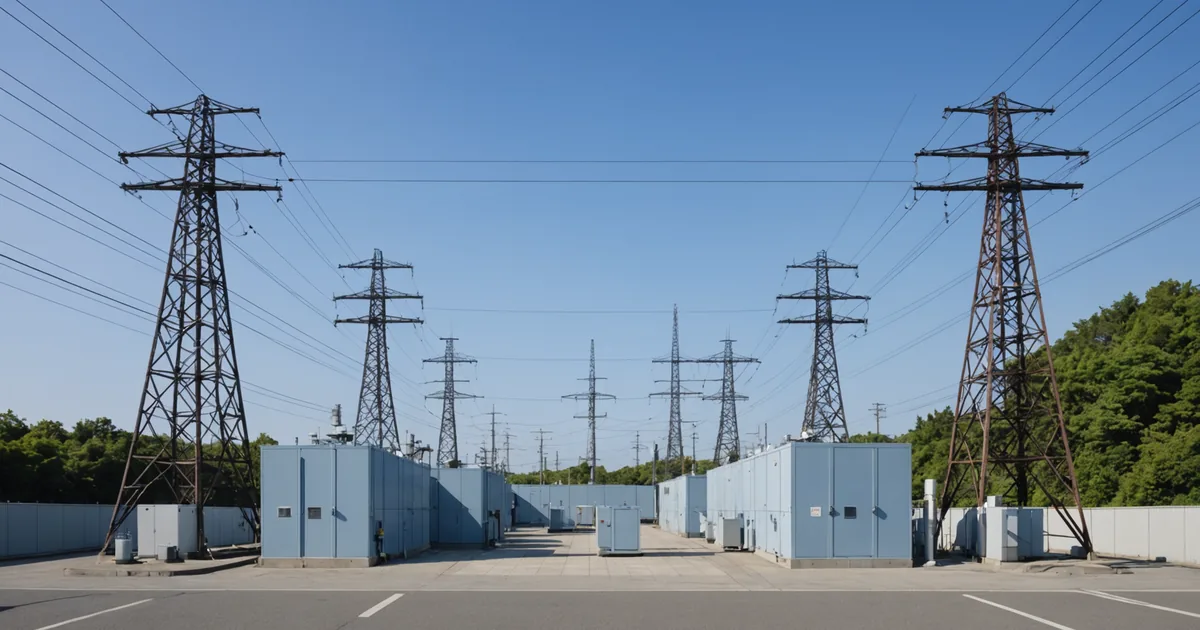

Japan's electricity market liberalization has proceeded incrementally since 2016, and the resulting regulatory architecture is complex enough that storage asset owners are still actively working out how to operate within it. The Organization for Cross-regional Coordination of Transmission Operators (OCCTO) plays a specific role in this structure: it oversees interconnection capacity allocation, cross-area trading, supply reliability standards, and the broader framework of grid-level rules that the nine area TSOs operate within.
For BESS dispatch strategy, the most operationally significant OCCTO rules concern scheduling obligations, imbalance settlement, and interconnection capacity allocation. Each shapes the feasible dispatch envelope in ways that are not intuitive if you approach Japan's market from a European or US dispatch context.
Scheduling Obligations and the Day-Ahead Lock-In
Japan's wholesale market operates on a system where generation and consumption participants must submit supply plans (kyokyuu keikaku) for the following day by a specified cutoff time, typically 12:00 noon for the next operating day. OCCTO aggregates these plans to assess the system balance and identify where additional reserves or interconnection capacity may be needed.
For a BESS paired with solar generation, the supply plan includes both the expected solar generation profile and the expected battery charge/discharge schedule. Once submitted, the plan becomes the reference point for imbalance settlement. Actual generation and consumption that deviates from the submitted plan is settled at the area imbalance price, which can be punitive during constrained periods.
This creates a firm incentive to submit accurate day-ahead plans, which in turn creates a demand for accurate day-ahead solar forecasts. A BESS dispatch system that submits optimistic solar generation forecasts in the day-ahead plan and then consistently delivers less, triggering imbalance settlement charges, is not optimizing revenue. It is trading dispatch efficiency for penalty costs. The quality of the day-ahead forecast is not a technical nice-to-have. It is directly linked to the site's financial settlement position.
Intraday Plan Revisions and the Window for Correction
OCCTO and the area TSOs allow plan revisions on an intraday basis. The specific revision cutoff varies by area operator and by the nature of the plan being revised. In general, revisions for the next delivery hour can be submitted up to approximately one hour before delivery, though the exact timing and the constraints on how large a revision is permissible differ between areas and participant types.
This intraday revision window is the operational space in which short-range forecasting and intraday dispatch optimization have their highest value. A battery dispatch system that updates its rolling solar forecast every 30 minutes and re-solves the dispatch plan for the remaining delivery hours can submit incremental plan revisions that bring the settlement position closer to actual delivery. This reduces imbalance exposure without requiring the day-ahead plan to be perfect.
The tradeoff is that frequent plan revisions impose an operational overhead and require the system to be integrated with the area TSO's electronic submission infrastructure. Not all BESS management systems have this integration. Those that do not are effectively forfeiting the intraday correction window, leaving their imbalance exposure at whatever the morning's day-ahead forecast happened to produce.
Interconnection Capacity Allocation and Congestion Effects
Japan's nine area transmission systems are connected by tie lines with limited capacity. OCCTO manages the allocation of this interconnection capacity through a market mechanism that allows registered participants to bid for cross-area transfer rights. For most co-located solar-BESS operators, cross-area interconnection is not a primary operational concern: their storage asset is selling into the local area market and not transacting cross-area.
However, interconnection congestion has an indirect effect on storage dispatch strategy through its influence on area price differentials. When congestion is binding, JEPX area prices diverge: the surplus area (often Kyushu with high solar output) sees lower prices than the deficit area (often TEPCO or Tohoku with limited local renewables). A BESS in Kyushu that expects lower area prices during the midday solar peak will rationally hold back from discharging at prices that a BESS in Tohoku might find attractive for the same delivery hour.
This means the dispatch optimizer needs to use area-specific JEPX price forecasts, not system-wide average price forecasts. The difference between a Kyushu area price and a TEPCO area price on a constrained day can be meaningful for dispatch economics, and a system that treats them as equivalent will make systematically wrong arbitrage decisions on congested days.
Output Control Instructions and OCCTO's Role
OCCTO has expanded oversight over renewable output control (shutsuryoku seiyaku) as solar penetration has grown. The framework distinguishes between the area TSO's instruction authority (which is the immediate operational path for most curtailment instructions) and OCCTO's broader system reliability role.
In practice, curtailment instructions to individual generators come from the area TSO, not directly from OCCTO. But OCCTO's system reliability standards and interconnection rules set the framework within which area TSOs determine when curtailment is necessary. A battery dispatch strategy that aims to reduce curtailment exposure needs to understand how the area TSO makes its curtailment decisions within this framework: what triggers an instruction, how much advance notice is typical, and what the area's historical pattern of curtailment volume and timing looks like.
This is Japan-specific knowledge. Operators who built their dispatch understanding in a European or US market context need to rebuild it from scratch for the Japanese regulatory environment. The OCCTO rule set has evolved significantly since 2016, and some of the older documentation circulating in industry briefings reflects rules that have since been revised.
Imbalance Penalties and the Case for Forecast Investment
Japan's imbalance settlement mechanism applies different pricing for excess and deficit imbalances, and the penalty rates can be multiples of the prevailing JEPX spot price during tight system conditions. The exact settlement pricing is determined by area and by the nature of the imbalance. OCCTO publishes the settlement rules, and they are revised periodically as the market evolves.
The economic case for investing in higher-quality solar forecasting and tighter intraday dispatch optimization is, in part, an imbalance penalty avoidance case. If a 1% improvement in day-ahead irradiance forecast accuracy on partly-cloudy days reduces daily imbalance settlement charges by some measurable amount per site, and a site runs 200+ partly-cloudy days per year, the economics of better forecasting become straightforward to evaluate. We are not quoting a specific number here because the correct number is site-specific and depends on the site's JEPX settlement position and the area's imbalance pricing history.
The point is that the OCCTO regulatory framework makes forecast quality a financial variable, not just a technical one. That reframing changes how storage asset owners should think about the cost of the forecasting and dispatch stack they are running on their sites.